For choosing the correct size of valve the online tool, Valve Dimensioning Tool can be used.
The calculation is based on water with a density of 1 kg/dm³.
With choosing the valve the dimension of pipeline is not important, but the operational characteristic.
Usually valves are often oversized and unable to provide sufficient control.
Smaller sized valves use more stroke / rotation to control as the bore is smaller than the pipeline's.
The working point (valve opening) should be so, that there is sufficient space for the valve to move in open as well as in closed direction
The following is needed to:
- Inlet pressure P1
- Outlet pressure P2 (if P2 is not known, ΔP of 15% can be used)
- Minimal flow rate l/h or gpm (1 l/h = 15.85 gpm)
- Maximum flow rate l/h or gpm (1 l/h = 15.85 gpm)
The following example is with a Diaphragm Valve.
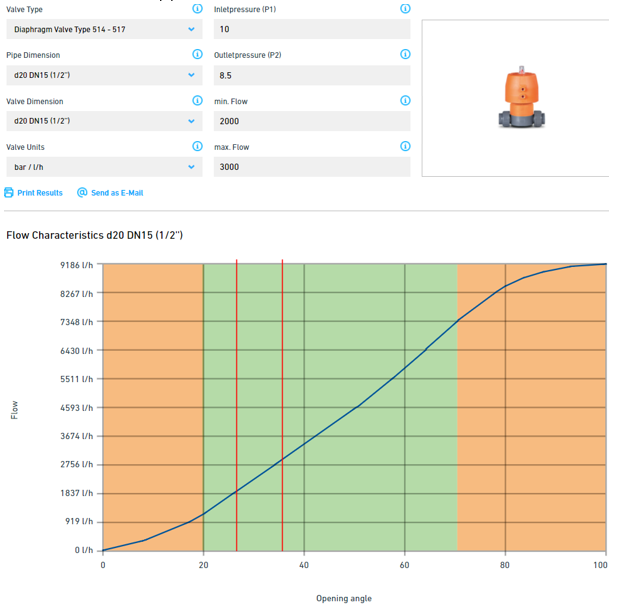
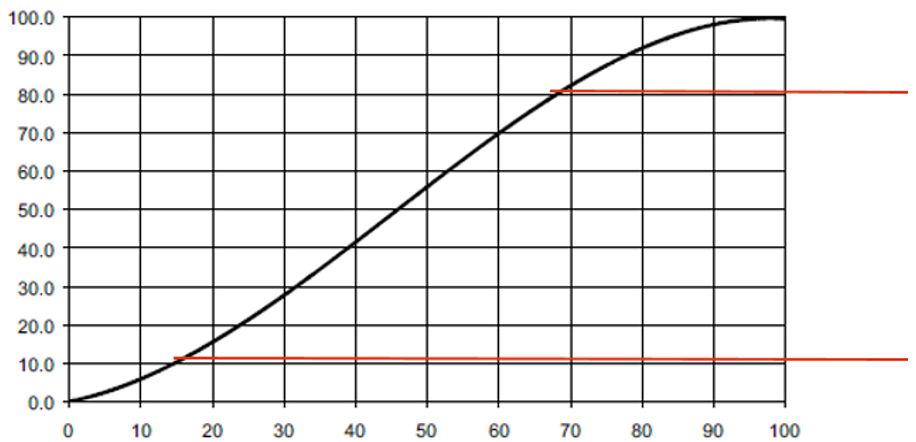
Operation range, which is ideal for the diaphragm valve, is between the two red lines.
The following data is provided:
- Inlet pressure 10bar
- Outlet pressure unknown (85% of inlet pressure = 8.5bar)
- Minimal flow rate: 2000 l/h
- Maximum flow rate: 3000 l/h
- Customer's pipeØ: DN25
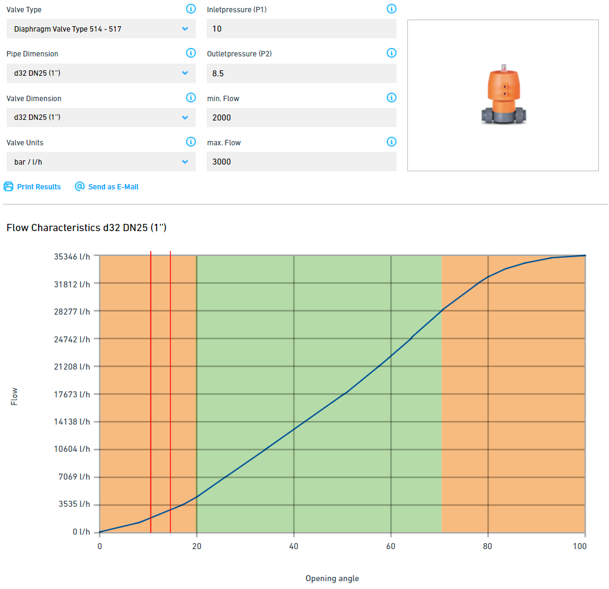
Diaphragm Valve DN25
Not advised to use a DN25 valve. Due to the limited opening the valve will vibrate and will provide insufficient control of the flow rate.
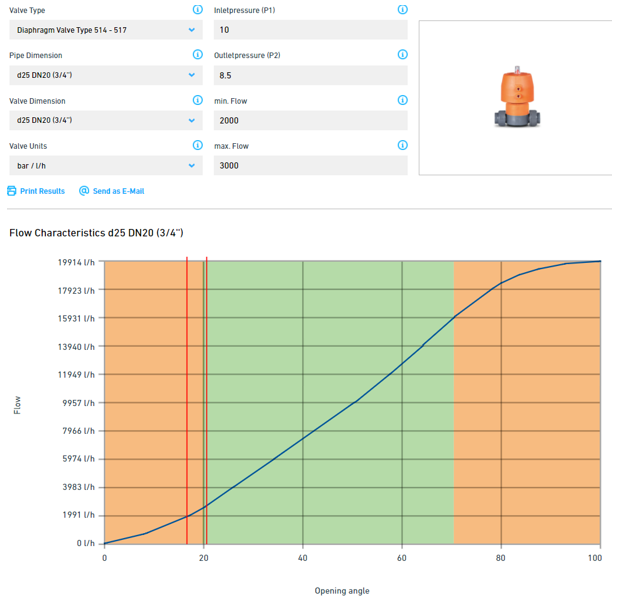
Diaphragm Valve DN20
Not advised to use a DN20 valve. Due to the limited opening the valve will vibrate and will provide insufficient control of the flow rate.
Diaphragm Valve DN15
Diaphragm Valve DN15 is the correct size for the optimum control of the flow rate. The valve is two DN-sizes smaller than the pipeline.